Who We Are
A first-of-its-kind collaboration between UCSF Health and the Department of Medicine’s Division of Clinical Informatics and Digital Transformation.
Our interdisciplinary group of informaticists, clinicians, data engineers, and researchers, collaborates to ensure that enterprise AI models deployed in clinical care across the health system are comprehensively evaluated and continuously monitored. We also contribute to advancing the science and methods of AI monitoring in healthcare.
What We Do
Monitor AI across the health system to ensure it is effective, safe, and unbiased.
We develop comprehensive measurement sets and monitoring frameworks that evaluate AI’s impact across key domains critical to healthcare. Our gold-standard approach is designed around ethical and trustworthy principles, ensuring that AI serves as a beneficial tool in improving healthcare delivery and clinical outcomes.
Our Mission
Build an automated AI monitoring platform that delivers continuous, reliable oversight of AI tools deployed across UCSF’s health system.
We aim to improve clinical and operational performance and ensure safety, equity, and transparency. The IMPACC platform also fuels research that redefines how AI is monitored in healthcare, setting new standards for responsible oversight and accountability to ensure these tools are safe and effective for patients nationally.
IMPACC News
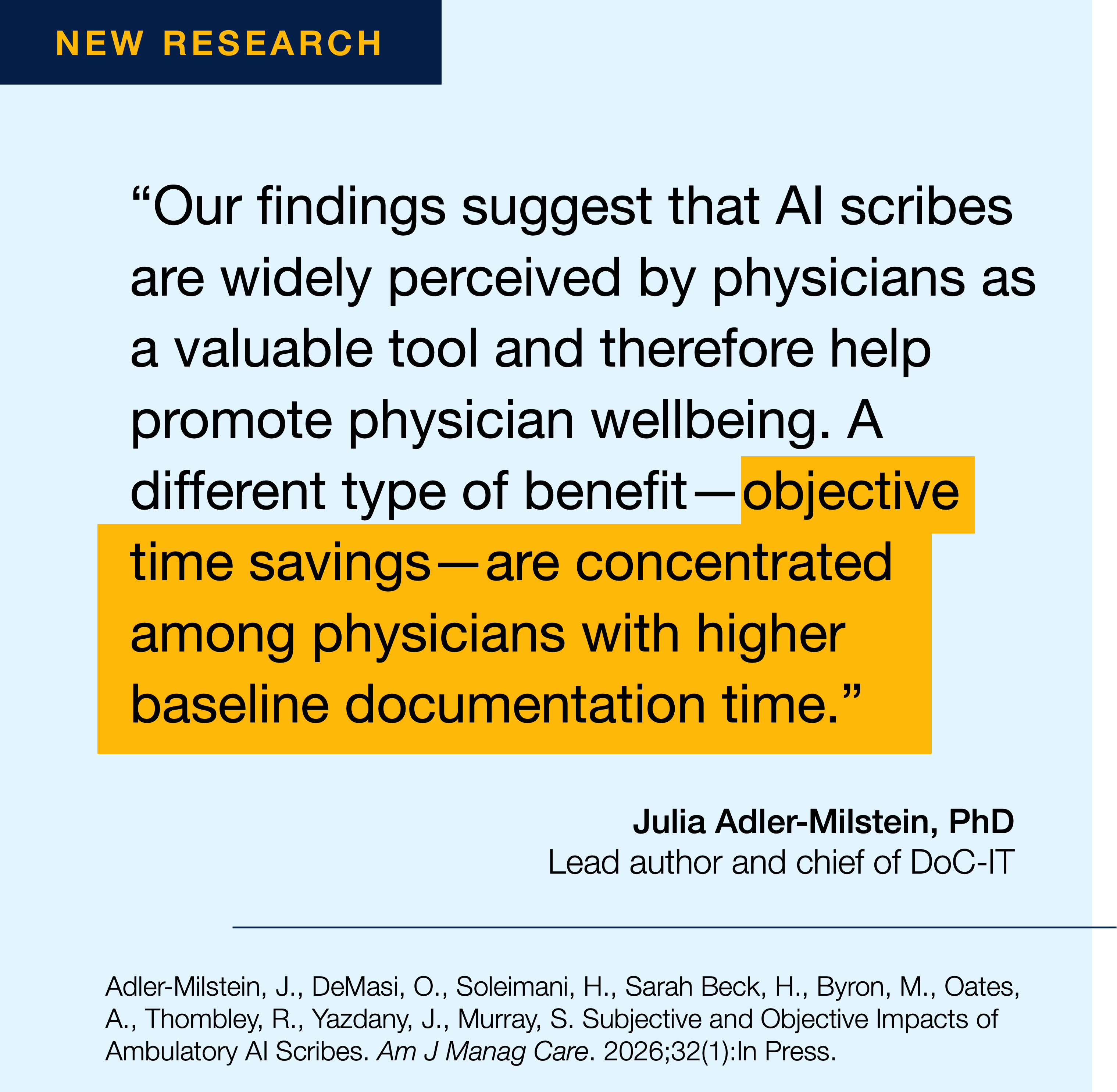
UCSF Study Identifies Varied Benefits from AI Scribes with Implications for Return on Investment
Findings show AI scribes reduce documentation burden, but benefits vary by physician baseline efficiency. Read more here.
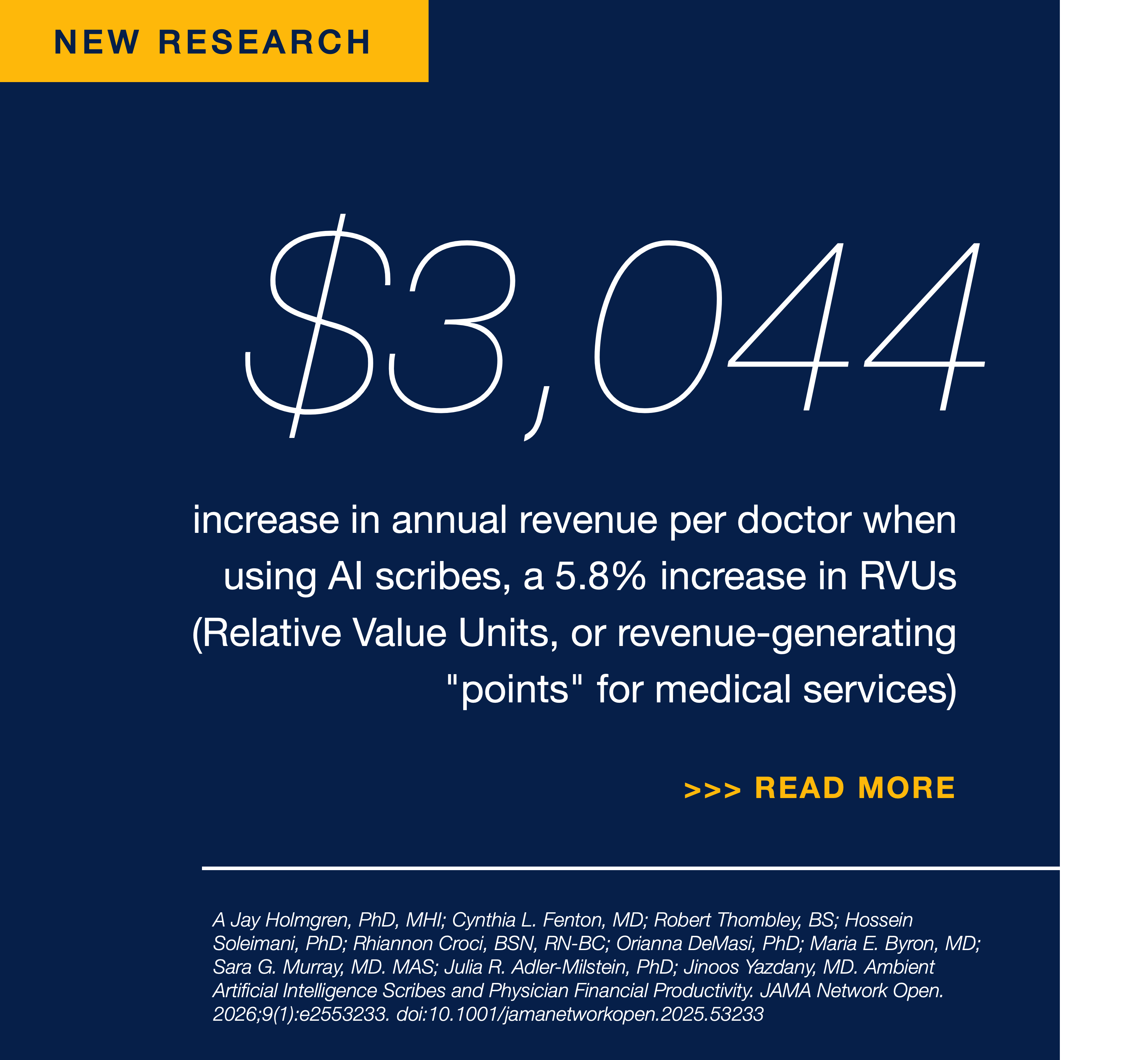
UCSF Study Finds AI Scribes Associated with Increased Physician Productivity and Revenue
Research published in JAMA Network Open shows 5.8% RVU increase among AI scribe adopters, with no rise in claim denials. Read more here.

Conferences and Presentations
Our team has been proud to contribute to leading conferences across medicine, machine learning, and health policy. Explore highlights from previous conferences to see how our work is helping define standards for trustworthy AI in healthcare.
AcademyHealth 2026
- Panel: Scaling AI Monitoring in Clinical Settings and the Role of HSR
- Podium: Patient and Physician Perceived Benefits and Risks with AI Clinical Scribes: A Qualitative Study
- Poster: Real-World Adoption of Ambient AI Scribes In an Academic Health System
- Poster: The Impact of Ambient AI Scribes on Physician Financial Productivity
AMIA CIC 2026
- Podium: Building Trust in AI Scribes: Consensus-Driven Metrics for Monitoring Their Impact in Academic Health Systems
- Podium: Changes in Ambulatory Physician Burnout and EHR Time with Use of Artificial Intelligence Scribe Technology
- Poster: Impact of an Inpatient Chart Summarization Tool in a Real-World Clinical Setting
UCSF Research AI Day
Machine Learning for Health (ML4H) 2025
AMIA 2025
- Panel: A Framework for Developing Metrics for AI Monitoring
-
Panel: Scaling AI Monitoring in Clinical Care: Platforms, Processes, and Problems
AMIA CIC 2025
AI Monitoring Existing Evidence
|
Subjective and Objective Impacts of Ambulatory AI Scribes. Adler-Milstein J, DeMasi O, Soleimani H, Beck S, Byron ME, Oates A, Thombley R, Yazdany J, Murray SG. |
|
Ambient Artificial Intelligence Scribes and Physician Financial Productivity. Holmgren AJ, Fenton CL, Thombley R, Soleimani H, Croci R, DeMasi O, Byron ME, Murray SG, Adler-Milstein J, Yazdany J. |
|
Kim JY, Hasan A, Kellogg KC, Ratliff W, Murray SG, Suresh H, Valladares A, Shaw K, Tobey D, Vidal DE, Lifson MA, Patel M, Raji ID, Gao M, Knechtle W, Tang L, Balu S, Sendak MP. |
|
Rotenstein LS, Wachter RM. |
|
Current Use And Evaluation Of Artificial Intelligence And Predictive Models In US Hospitals. Nong P, Adler-Milstein J, Apathy NC, Holmgren AJ, Everson J. |
|
The Limits of Clinician Vigilance as an AI Safety Bulwark. Adler-Milstein J, Redelmeier DA, Wachter RM. |
|
Adler-Milstein J, Chen JH, Dhaliwal G. |