IMPACC News
UCSF Study Identifies Varied Benefits from AI Scribes with Implications for Return on Investment
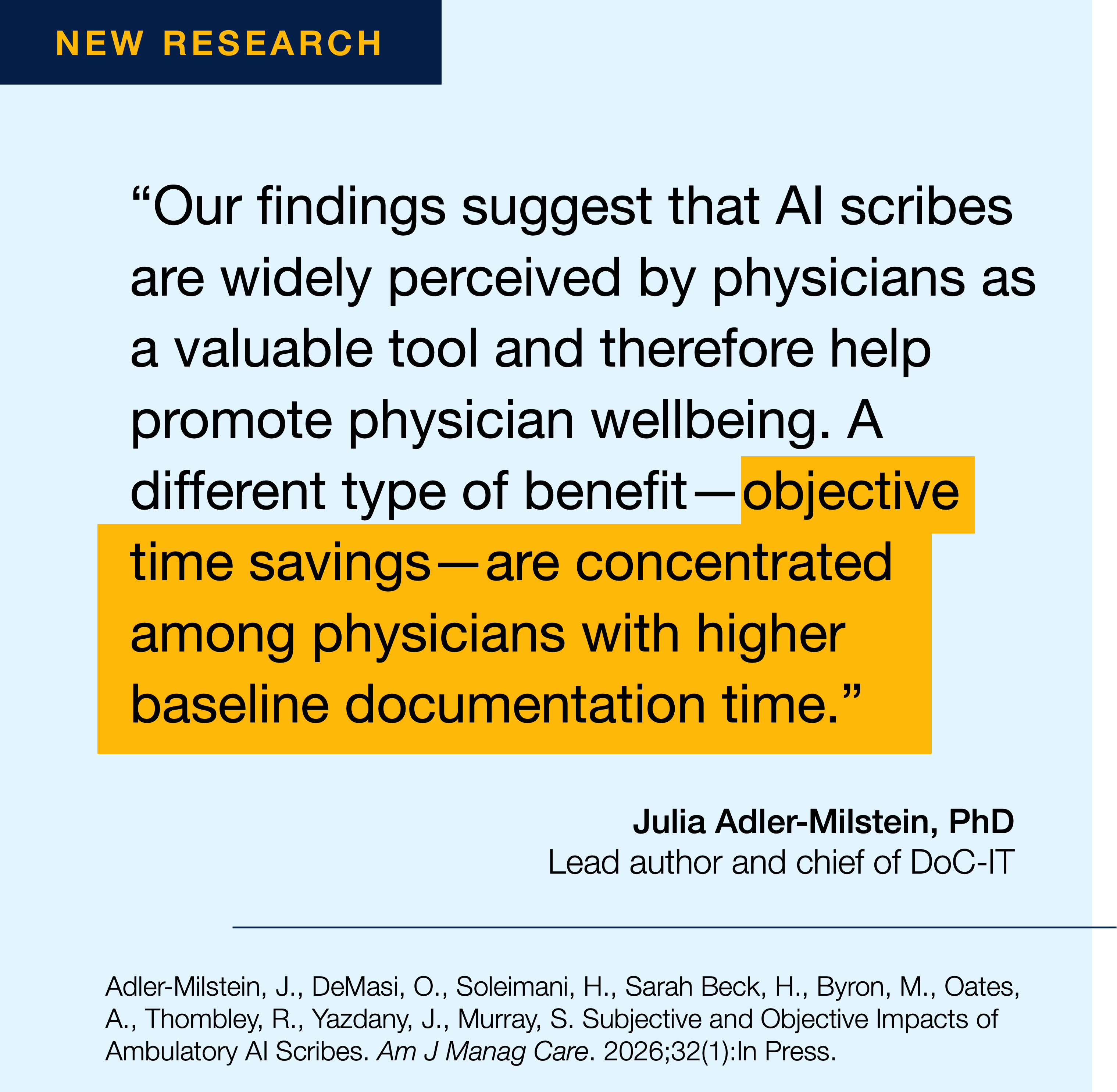 Findings show AI scribes reduce documentation burden, but benefits vary by physician baseline efficiency. Read more here.
A new study led by UCSF researchers and published in the American Journal of Managed Care (health IT special issue) offers new insights into how AI scribes impact physician work experience and documentation time. The research, which examined over 300 ambulatory physicians across multiple specialties at UCSF, reveals a more complex picture than previously understood about who benefits most from this emerging technology.
The study, titled "Subjective and Objective Impacts of Ambulatory AI Scribes," found that while 86.5% of physicians perceived reductions in documentation time after adopting AI scribe technology, the actual time savings were modest and not strongly correlated with perceived benefits. This suggests that different groups of physicians may be deriving different types of benefits from the technology.
Most significantly, the research identified that physicians with higher baseline documentation time—those who spent more time on clinical notes before AI scribe adoption—realized the majority of actual time savings.
UCSF Study Finds AI Scribes Associated with Increased Physician Productivity and Revenue
 Research published in JAMA Network Open shows 5.8% RVU increase among AI scribe adopters, with no rise in claim denials. Read more here.
Physicians who adopted ambient artificial intelligence (AI) scribe technology experienced significant increases in productivity and revenue without compromising documentation quality, according to new research published in JAMA Network Open.
The study, conducted by researchers at UCSF, analyzed nearly 1.2 million ambulatory encounters across 1,565 physicians between January 2023 and April 2025. Among the physicians studied, 698 (44.6%) adopted AI scribe technology, while 867 remained non-adopters.
A key finding showed that AI scribe adopters generated 1.81 more relative value units (RVUs) per week compared to non-adopters, which is a 5.8% increase that translates to approximately $3,044 in additional annual revenue per physician based on 2025 Medicare payment rates. The 1.81 RVU per week increase could help healthcare systems offset the expense of AI scribe implementation. Understanding the financial implications also informs policymakers about potential impacts on healthcare spending as AI scribe adoption accelerates.
The study also found that AI scribe adopters handled 0.80 more patient encounters per week, representing a 2.8% increase in visit volume. There was also no difference in the proportion of insurance claims denied between adopters and non-adopters, suggesting that AI-generated documentation met payer standards.
Sarah Pollet, MPH and Julia Bongiorno, PMP, MSHC explore the evolving role of AI in clinical environments with Vizient

Click here to listen to the podcast.
Jinoos Yazdany, MD, MPH, Named Executive Director of AI Monitoring in Clinical Care
The Division of Clinical Informatics and Digital Transformation (DoC-IT) is pleased to announce that Jinoos Yazdany, MD, MPH, has been named the inaugural Executive Director of AI Monitoring in Clinical Care. In her new role, Jinoos will lead IMPACC—the Impact Monitoring Platform for Clinical Care—a pioneering collaboration between UCSF Health and DoC-IT.
Foundation of IMPACC
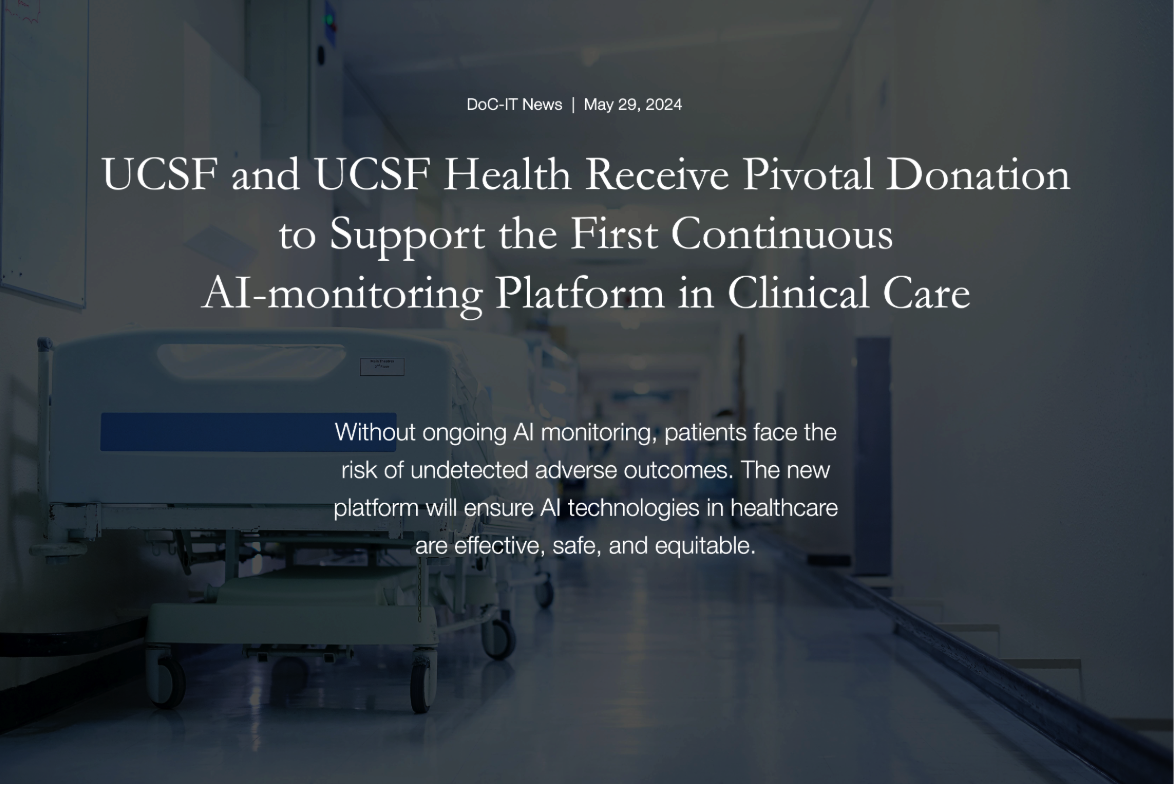 The Impact Monitoring Platform for AI in Clinical Care (IMPACC) aims to bridge the gap between the rapid evolution of AI technologies used by clinicians and the essential need for robust, ongoing assessment of their efficacy, safety, and equity.
Currently, the healthcare field lacks established protocols for ongoing AI monitoring, leading to risks of adverse outcomes for patients and healthcare providers that go undetected. While assessments are conducted to determine the suitability of new AI technologies for safe integration into clinical environments before deployment, once they are deployed, health systems need a way to promptly identify any issues in their real-world performance.
IMPACC will fill this urgent need by shifting from planned, periodic, manual monitoring of a focused set of measures to real-time, continuous, automated, and longitudinal monitoring across a broad measure set with specified criteria for escalation to human review and intervention.
Learn more about the creation and launch of IMPACC here.