New UCSF Study Links Inpatient 4Ms Adherence to Better Outcomes for Older Adults
Hospitals nationwide, participating in the Age-Friendly Health System movement, have widely adopted a set of care practices known as the “4Ms” to support older patients. The 4Ms stands for “What Matters, Medication, Mentation, and Mobility.” But until now, there was no evidence of exactly how much of this care needed to be implemented and how often it needed to be done to make a difference.
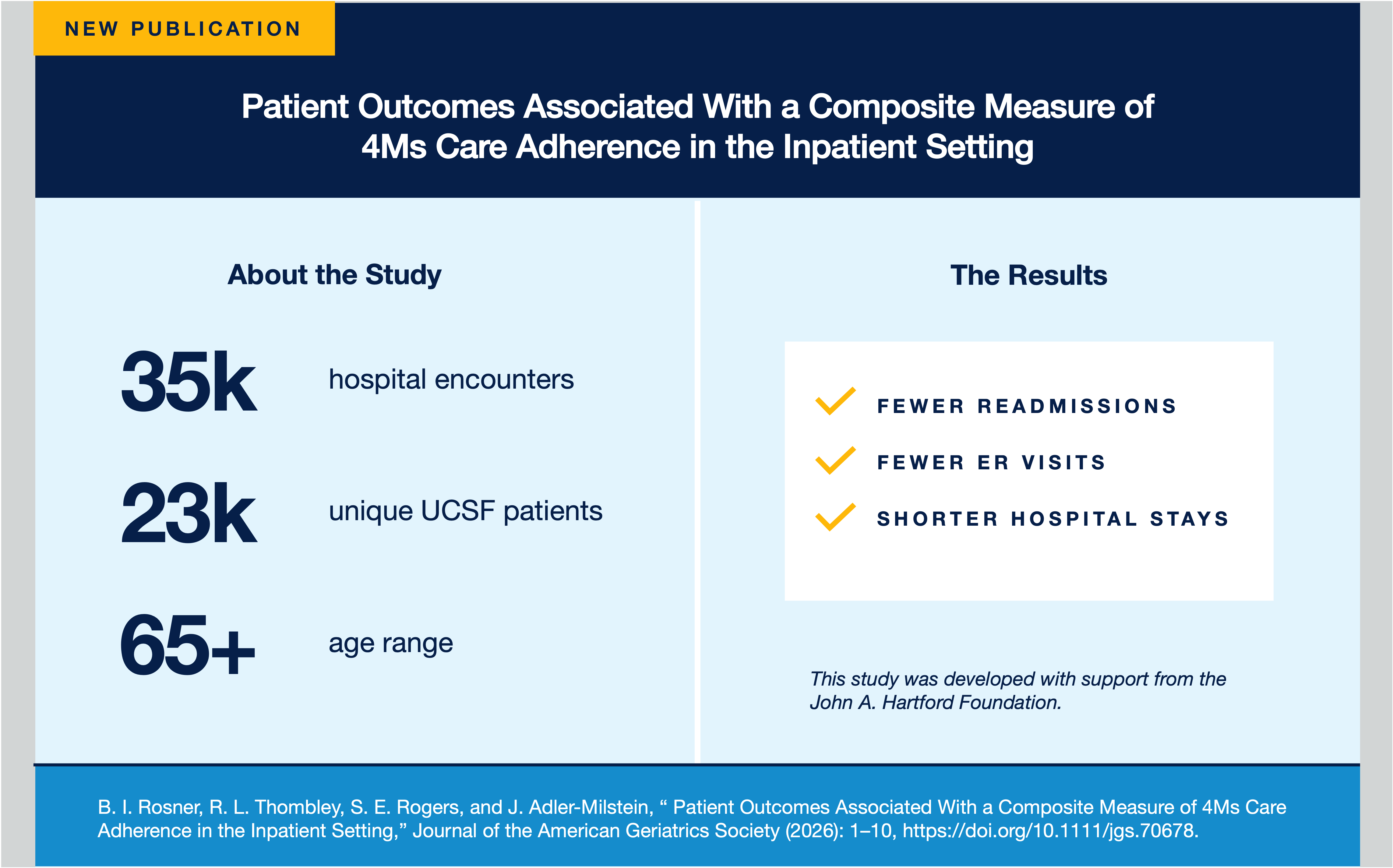 A new study from UCSF published in the Journal of the American Geriatrics Society set out to find the answers. The researchers looked at nearly 23,000 patients aged 65 and older across approximately 35,000 hospital stays between 2001 and 2024.
The team tracked how closely hospital staff followed 4Ms practices during each patient’s stay, then compared that to real outcomes. Key questions included:
- Did patients end up back in the hospital?
- Did they visit the Emergency Department (ED)?
- How long did they stay?
- Did they need to move to a skilled nursing facility (SNF) afterward?
The results showed promising evidence about the effectiveness of 4Ms care. Patients who received more consistent 4Ms care were less likely to be readmitted within 30 days. They also had fewer ED visits and shorter hospital stays overall. Even modest levels of adherence to the 4Ms made a measurable difference.
The one outcome that didn’t change was whether patients were discharged to an SNF, which was roughly the same regardless of how closely staff followed the 4Ms.
The findings provide hospital leaders with concrete evidence of the connection between adherence to the 4Ms and improved patient outcomes. Rather than aiming for 100% compliance across the board, which researchers found to be a lofty target that was hard to accomplish in real clinical practice, they can focus resources on reaching realistic adherence targets, resulting in better outcomes for older patients without stretching hospital staff too thin.
“What is important for patients, hospital clinicians, and hospital administrators is that when 4Ms screenings are done as recommended, and complete 4Ms actions are taken in at least 25%-50% of shifts, there are meaningful improvements in outcomes that should matter to patients, families, and health systems alike. While adhering to 100% of 4Ms may be difficult to achieve in real-world inpatient practice, our study found realistic and pragmatic targets, demonstrating that the greater the adherence, the better the outcomes.”
Ben Rosner, MD, PhD, FAMIA
Clinical Professor of Medicine, UCSF Division of Clinical Informatics and Digital Transformation (DoC-IT)
This study was developed with support from the John A. Hartford Foundation.
B. I. Rosner, R. L. Thombley, S. E. Rogers, and J. Adler-Milstein, “ Patient Outcomes Associated With a Composite Measure of 4Ms Care Adherence in the Inpatient Setting,” Journal of the American Geriatrics Society (2026): 1–10, https://doi.org/10.1111/jgs.70678.